

The Dance of Tauste and The Crystal Rosary
What does this festival consist of?
This dance is held in honour of the patron saints of Tauste. It is performed by twelve dancers and the musical accompaniment is provided by two dulzainas and a tambourine. It has been performed by the Estella Piper-Dulzaineros since the 19th century. More recently, the Tauste Piper-Dulzaineros have joined the group.
The dancers take part in the festivities in honour of the Virgin of Sancho Abarca, which are held between 20 and 25 April, and in the September festivities, in honour of San Miguel from 20 to 23 September, which takes place on the 21st during the procession.
The folk costumes of the dancers are of two kinds: The white or gala costume, and the purple costume, which is the costume worn by the well-to-do farmers of the town, and can be seen on the participants of the human towers.
The human towers are part of the fiesta. In which different figures are formed with names that represent them, such as: Cucuño, Pulso, Caballos and San Miguel.
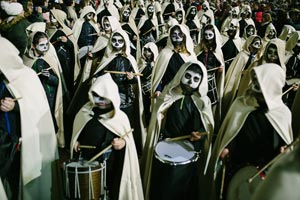
The glass rosary is formed by a procession where instead of beads there are polychrome glass lanterns carried by people representing the prayers of the rosary.
During the April festivities (the first three days) the following programme stands out:
Day 20 April. Eve Day.
Dance and procession to the Church of Santa María where the Solemn Salve to the Virgin of Sancho Abarca is held.
21st April.
Day of the Virgin of The dancers attend mass, after which the dance is held in the Plaza de España and consists of the following parts:
- Greeting or presentation.
- 2 parts of swords.
- 2 parts of sticks.
- 4 parts of bows.
- 2 parts without instruments: Fifth part, "Jota" style and Madre de los Pollos.
- 4 human towers: Cucuño, Pulso, Caballos and San Miguel.
- Farewell or march.
22nd April. Day of the Little Virgin.
The dancers walk through the streets and make stops at the illustrious houses, including those of the queens of the fiesta (the main and children's queens) and the mayor, among others.
At 21:00 the magnificent Crystal Rosary is carried in procession, followed by a farewell to the virgin in which two dances are performed. A human tower is made, a human tower in which the Rabadán bids farewell.