

The Empalaos of Valverde de la Vera
The Empalaos is a religious celebration that takes place on the night of Maundy Thursday to Good Friday in the town of Valverde de la Vera, in the region of La Vera in Cáceres, Spain. This tradition, declared of National Touristic Interest in 1980, has its origin in the Brotherhood of the Vera Cruz and Passion of Christ, which was established in 1715.
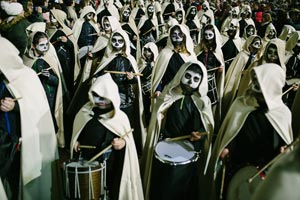
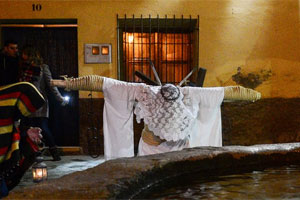
The act of dressing as an Empalao is related to a promise made to God and the Brotherhood of the Vera Cruz and the Empalaos. It consists of walking barefoot through the streets of Valverde de la Vera carrying a cross tied to the body through a complicated dressing process and carrying a crown of thorns. In addition, their faces are covered with a white veil to maintain anonymity, and two swords in the form of a cross are crossed behind their necks.
During the procession, the Empalaos are accompanied by their cirineos, who light their way and help them in case of falls. The route, which takes place in absolute silence and in the midst of an atmosphere of mystery and devotion, includes the 14 stations of the Via Crucis through the typical steep and rocky streets of Valverde de la Vera. The most emotional moment of the procession is when two Empalaos cross each other and kneel in a sign of mutual respect.
The process of dressing the Empalao is complex and must be done with great care to avoid injury to the body. First, a white dress is placed from the waist to the ankles, then the torso and arms are wrapped with rope. Next, a wooden mast is placed horizontally over the shoulders as a cross.
At the end of the route, the Empalaos return to the place where they were dressed to be assisted by their families and dressers, who will rub them with alcohol to activate their circulation. The tradition is so popular that it has its own museum since 2003, located in a typical Verata house in the town, which tells the story of this festival.
The Empalaos of Valverde de la Vera is closely related to the Picaos of San Vicente de la Sonsierra and is one of the most important celebrations in the region.